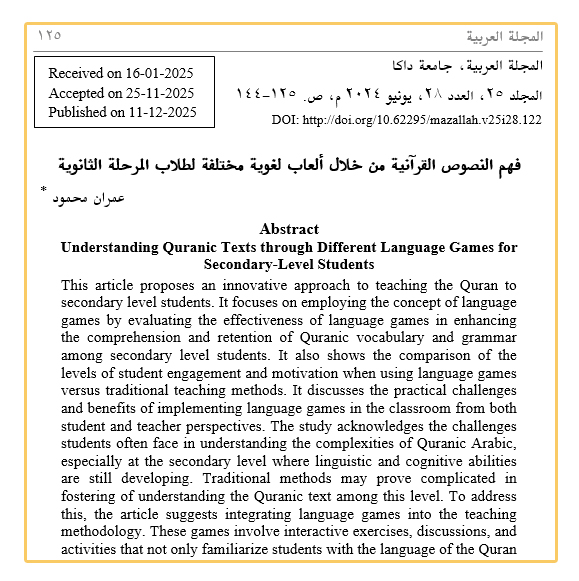
فهم النصوص القرآنية من خلال ألعاب لغوية مختلفة لطلاب المرحلة الثانوية
DOI:
https://doi.org/10.62295/mazallah.v25i28.122Keywords:
Quranic text, Traditional methods, Language games, High schoolstudentsAbstract
Abstract
This article proposes an innovative approach to teaching the Quran to secondary level students. It focuses on employing the concept of language games by evaluating the effectiveness of language games in enhancing the comprehension and retention of Quranic vocabulary and grammar among secondary level students. It also shows the comparison of the levels of student engagement and motivation when using language games versus traditional teaching methods. It discusses the practical challenges and benefits of implementing language games in the classroom from both student and teacher perspectives. The study acknowledges the challenges students often face in understanding the complexities of Quranic Arabic, especially at the secondary level where linguistic and cognitive abilities are still developing. Traditional methods may prove complicated in fostering of understanding the Quranic text among this level. To address this, the article suggests integrating language games into the teaching methodology. These games involve interactive exercises, discussions, and activities that not only familiarize students with the language of the Quran but also encourage critical thinking and analytical skills. The article outlines specific language games tailored to different aspects of Quranic study, such as vocabulary acquisition, grammar comprehension, and interpretation of verses. In conclusion, the article explores some recommendations according to the findings to integrating language games into the teaching methodology for educators to facilitate meaningful Quranic education at the secondary level, nurturing both linguistic proficiency and spiritual understanding among students.
References
References:
عبد العزيز، ن. م. (1973). الألعاب اللغوية في تعليم اللغة الأجنبية. دار المريخ للنشر، الرياض.
Whiting, D. (2016). Language‐Games, and Forms of Life.
Lee Su, K. (1995). Creative Games for the Language class. In English Teaching Forum (Vol. 3).
Langran, J., & Purcell, S. (1994). Language Games and Activities. Netword 2: Teaching Languages to Adults. Centre for Information on Language Teaching and Research, 20 Bedfordbury, Covent Garden, London WC2N 4LB, England, United Kingdom. page 8
Bruner, J. (1972). Nature and Uses of Immaturity. American Psychologist.
Cahyani, F. (2020). The Effect of Language Games on Vocabulary Mastery. Journal of Language Teaching and Research, 11(4), 631-639.
Crystal, D. (2001). Language and the Internet. Cambridge University Press.
Lave, J., & Wenger, E. (1991). Situated Learning: Legitimate Peripheral Participation. Cambridge University Press.
Nation, P. (2001). Learning Vocabulary in Another Language. Cambridge University Press.
Prensky, M. (2001). Digital Game-Based Learning. McGraw-Hill.
Vygotsky, L. S. (1978). Mind in Society: The Development of Higher Psychological Processes. Harvard University Press.
Wittgenstein, L. (1953). Philosophical Investigations. Blackwell Publishing.
Piaget, J. (1962). Play, Dreams and Imitation in Childhood. Norton.
Britannica, T. Editors of Encyclopaedia (2024, June 16). bingo. Encyclopedia Britannica. https://www.britannica.com/topic/bingo-game-of-chance